Operations & Strategy
Managed Outsourcing vs. EOR: Which Model Is Right for Your Bilingual Team?
Two models, very different implications. Here is how to determine whether managed outsourcing or an Employer of Record structure is the right fit for your bilingual team.

When a company decides to build or expand a bilingual FR/EN team offshore, one of the first — and most consequential — decisions it will face is not about talent. It is about structure.
Two models dominate the landscape: managed outsourcing, in which a partner takes full operational responsibility for your team, and the Employer of Record (EOR) model, in which you retain direct control over your team while a partner manages the legal and administrative infrastructure of employing them.
Both are valid. Both serve different needs. And choosing the wrong one — or defaulting to one without a clear rationale — can cost considerably more than the decision deserves.
This article is designed to help you think through that decision with clarity.
The Managed Outsourcing Model
In a managed outsourcing arrangement, your partner does not simply provide staff. They take ownership of the entire operational layer: sourcing, onboarding, training, quality management, performance oversight, and ongoing optimisation. You define the outcomes. They build and run the team that delivers them.
This model tends to be the right fit when:
You want outcomes, not headcount. If your priority is a high-performing bilingual CX function, a responsive IT support team, or a reliable operations capability — and you do not want to manage the day-to-day complexity of running it — managed outsourcing is designed for exactly that.
You are moving quickly. A well-structured outsourcing partner can have a team operational in two to four weeks. Building an equivalent team through direct hiring — even with an EOR — takes considerably longer, particularly for bilingual roles.
You do not have the internal infrastructure to manage a remote team. Running an offshore team well requires process documentation, quality frameworks, communication cadences, and performance visibility. If those systems do not exist in your organisation today, an experienced outsourcing partner brings them. An EOR does not.
You want a single point of accountability. With managed outsourcing, if something is not working, there is one conversation to have. That clarity has real operational value, particularly for senior leaders who do not want to be managing vendor relationships.
The EOR Model
An Employer of Record arrangement works differently. Here, you identify the people you want on your team — or your partner helps you find them — and the EOR becomes their legal employer in the country of operation. You direct the work. The EOR handles payroll, compliance, benefits, local labour law, and all the administrative complexity of employment in a jurisdiction where you do not have a legal entity.
This model tends to be the right fit when:
You want direct control over your team. Some organisations — particularly those with strong internal culture, specific technical requirements, or a desire to build long-term capability — want their offshore team to feel, operationally, like an internal team. The EOR model enables that, without requiring the legal overhead of entity setup.
You need to hire roles that do not fit a standard outsourcing scope. Managed outsourcing works best for defined functions — CX, IT support, operations. If you need a highly specific profile — a bilingual product manager, a French-speaking data analyst, a senior finance professional — the EOR model gives you the flexibility to hire for that role directly.
You are building toward permanence. Companies that anticipate growing a significant offshore presence over time often begin with an EOR — using it to establish their team and validate the model — before considering whether to establish their own entity.
You already have strong people management capabilities. The EOR handles the legal infrastructure. It does not manage your team. If you have the internal systems and leadership bandwidth to run a remote bilingual team effectively, the EOR model gives you maximum flexibility.
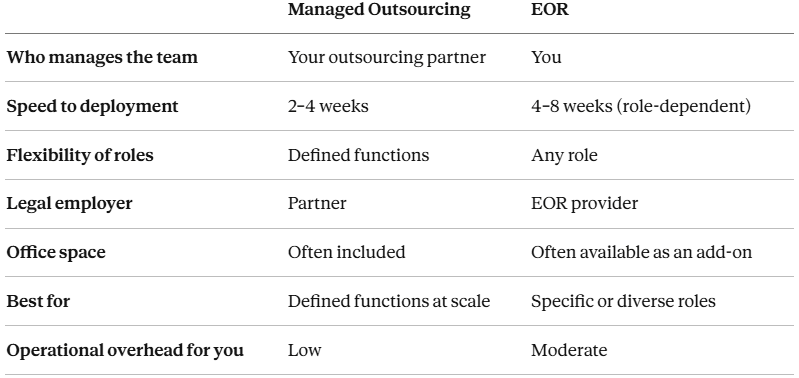
The Practical Differences
A Note on Hybrid Approaches
Many of our clients do not choose one model exclusively. A company might use managed outsourcing for its bilingual CX team — where volume, consistency, and operational quality are the priority — while using an EOR structure for a small number of specialist roles that do not fit the outsourcing model.
This is not a compromise. It is a considered use of each model for what it does best.
The Question to Start With
Before evaluating providers or comparing costs, the most useful question to answer is this: what kind of relationship do you want with your offshore team?
If the answer is "I want results, and I want someone I trust to deliver them" — managed outsourcing is likely your model.
If the answer is "I want a team that feels like mine, that I can shape and direct, with the legal complexity handled for me" — an EOR structure is worth exploring.
Both answers are right. The model should follow the answer.
—————————————————————————————————————————————
Aventriz offers both managed outsourcing and EOR solutions for bilingual FR/EN teams, with optional office space in India. If you would like to explore which model suits your situation, we would be glad to have that conversation.